Pavagada Fort
Pavagada Fort – The Sentinel of the Eastern Frontier
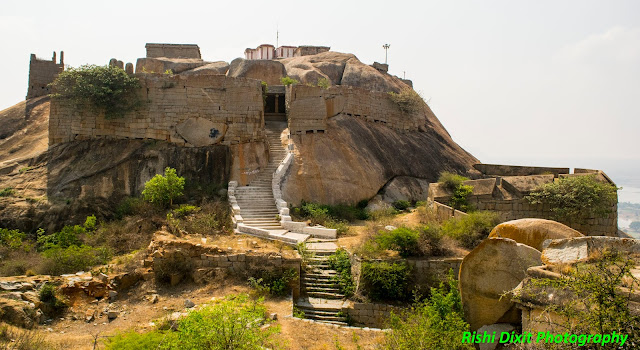
Rising dramatically above the dry plains of eastern Karnataka, Pavagada Fort stands as a silent witness to more than four centuries of warfare, political intrigue, and shifting empires. Perched atop a massive granite hill, the fort dominates the surrounding landscape, its rugged silhouette visible from miles away.
 |
| Fort View |
 |
| Majestic Boulders |
The fort hill rises to roughly 3,400 feet above sea level, making it one of the more prominent hill forts in this part of Karnataka.

Today, Pavagada is a bustling taluk town in Tumakuru district, but its origins are deeply intertwined with the turbulent history of the post-Vijayanagara period. The fort was constructed in 1586 by Ballappa Nayaka (also known as Mallappa Nayaka), a local chieftain who served under the Aravidu dynasty—the last ruling lineage of the once-mighty Vijayanagara Empire. As imperial authority weakened following the Battle of Talikota, regional Nayakas emerged as powerful rulers, and Pavagada became one of the important strongholds of the era.
Its location was no accident. The fort occupies a commanding position on a rocky hill that overlooks vast stretches of territory. From its ramparts, sentries could monitor movement across the plains and detect approaching armies long before they reached the base of the hill. This strategic advantage made Pavagada an important military outpost and a coveted prize for competing powers.
 |
| Steps to the top |
Approaching the entrance
 |
| Fort entrance with a wicket gate (aka kirkaporter) |
 |
| A ruined temple in the fort |
 |
| Fort bastion |
 |
| Entrance to the next tier |
 |
| Granaries |
Over the centuries, the fort changed hands several times, reflecting the shifting political landscape of southern India. It stood at the crossroads of influence between the Mysore region and the Deccan, finding itself caught in the ambitions of local chieftains, regional kingdoms, and larger imperial forces. Each ruler left behind traces of their presence, adding new layers to the fort's long and eventful history.
Remember this fort lies in an area studded with forts on other hills. These include (but not limited to): Devarayanadurga, Madhugiri, Channarayanadurga, Medigeshi etc.
I found many exisiting structures at the fort but I cannot assess what they were meant for. We must also remember that these are the few standing structures left. Others may have perished over time
 |
| Existing structures |
Unlike the lush hill forts of the Western Ghats, Pavagada possesses a stark and rugged beauty. The landscape is characterised by rocky outcrops, sparse vegetation, and sweeping panoramas that extend across the arid plains of Karnataka and neighbouring Andhra Pradesh. As the climb progresses, the fort gradually reveals its defensive character—massive walls, gateways, bastions, and strategic vantage points designed to make any assault a formidable challenge.

You would require an entire day to explore the fort so make sure you reach early in the morning to beat the sun
Miscellaneous Information
- Nearest Petrol Bunk & Puncture Shop: Pavagad town at the foot of the hill
- Nearest Hotel: Plenty of Eateries in Pavagada town but nothing luxurious.
- Nearest Police Station: Pavagad
- Local Hotels for Stay: Pavagad (but below average quality)
Pros:
- Easy to approach from the town.
- Safe: I have been there only once and have not encountered any hostility.
- No commercialization: Simply put – no ‘parking or entry’ fees, No solicitations for donations.
- No water available. Carry water and electrolytes
- Once the sun comes out, expect to get baked
- No dedocated parking space for vehicles. We parked our car in front of out hotel where we stayed
Location: https://maps.app.goo.gl/qnuGvrVeDoW89jJi8


Comments
Post a Comment