Kavaledurga Fort, Thirthahalli
Kavaledurga Fort, also historically known as Bhuvanagiri,
is an ancient 9th-century hilltop fortress hidden deep within the lush
rainforests of the Western Ghats near Thirthalli in Shivamogga district of Karnataka. It is around 20km from Thirthahalli
It is often defined as a ‘Sentinel’ fort. To clarify,
historically, a sentinel fort is a small, strategically placed military outpost
whose primary job isn't to withstand a massive, months-long siege, but to act
as the "eyes and ears" of an empire or territory. Another fort that
comes to mind is Jamalabad Fort although that fort is specifically defined as a
watchtower fort (see my blog on Jamalabad fort)
Coming back to Kavaledurga, it was expanded and heavily
fortified in the 14th to 17th centuries by the Keladi Nayakas. I am not
aware of any famous battles that it encountered but today, it stands as an
enchanting, offbeat trekking destination praised for its mist-covered ruins,
moss-covered steps, and panoramic views of the western ghats.
To begin with, once you reach here, you will have to park
your bike/car nearby and pay a fee. I would strongly advise carrying your own
water. The good news is that there are a couple of shops nearby that sell
packaged drinking water along with the usual soft drinks and processed,
packaged snacks (Chips, biscuits etc.)
Now that you have parked your vehicles, taken your water,
you may start the trek. Did I say ‘trek’? Well, there is no road to the main gate. So you have to walk for about 200
meters just to reach the main gate across paddy fields.
 |
| Cobbled path to the entrance |
 |
| Bastions loom large as you approach |
 |
| The entrance approaches |
A wide cobbled stone path leads you to the main entrance. The path is wide and upon entering, there are other doorways that lead you to the now-defunct temples.
Entering the fort


Sculptures at the sides of the fort entrance


Water Bodies: Now, for any fort to sustain itself, it requires water bodies. This fort has many.
I
have deliberately refrained from calling them ‘kalyanis’ as they do not fit the
description of a standard Kalyani. (I’m open to change if someone can explain)
 |
| Stepwell 1 |
 |
| Stepwell 2 |
 |
| Stepwell 2 |
 |
| Stepwell 3 |
 |
Stepwell 4 Stepwell 4 |
Caution: While everyone talks about this area being all about snakes, you have to be careful about scorpions. I found these scorpion remains near these stepwells


Ancient Temples: Kavaledurga fort houses beautifully
preserved stone shrines including the Kashi Vishwanath, Vijaya Vittala, and the
hilltop Srikanteshwara (Shikhareshvara) temple
The moment you cross the main entrance, The first building you encounter immediately after passing through the main inner gateways of Kavaledurga Fort is the Shikhareshwara Temple (also spelled Shikanteshwara).
 |
This picture was taken from a higher location |

 |
| Ruins |


 |
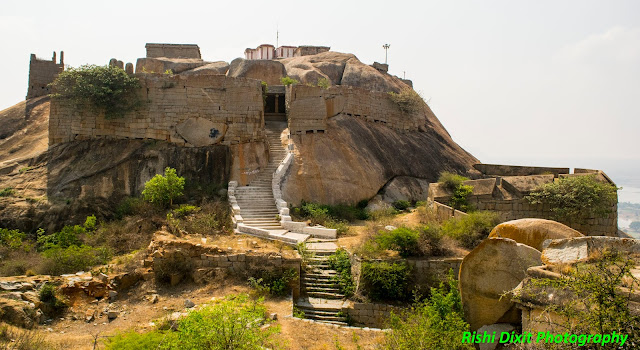
| View of the summit as you approach it |
 |
| Dilapidated ruins near the summit |
 |
| The shrine at the summit |
 |
| Side view of the shrine at the summit |
 |
| Random path towards the summit |


About 50m further up, you will see a small shop run by the local landowner there called Mamta Acharaya. She is a sweet, chatty person who sells everything cheaper. Very ethical lady and will give you gyan on what to see in the vicinity. I took her permission to photograph her and requested that I post it on my blog.Given below is her picture and her shop. She is helpful and full of animated conversation 😀


Miscellaneous information
- Nearest Petrol Bunk & Puncture Shop: Thirthahalli Town (20 km away) But with the passage of time, newer ones have opened up
- Nearest Hotel: Thirthahalli limited options.
- Nearest Police Station: Thirthahalli
- Local Hotels for Stay: Thirthahalli (but many homestays in the vicinity. (use Google maps)
Pros:
a) a) Easy to approach with ample parking place at the foot of the hill.
b) Safe: I have been there only once and have not encountered any hostility or faced any shady characters.
I recommend going in the monsoons but be careful of leeches


Comments
Post a Comment